

We believe the Dexcom G7 represents a meaningful upgrade over the G6, with its 60% smaller profile, 30-minute warm-up (versus 2 hours), and improved 8.2% MARD accuracy. The all-in-one design eliminates separate transmitter handling, while new features like Silent Mode and photo-based food logging enhance daily management. If you’re experiencing discomfort from the G6’s larger sensor or find the 2-hour warm-up disruptive, upgrading makes clinical sense. Below, we’ll break down exactly how these improvements translate to real-world benefits for your diabetes management.
Key Takeaways
- G7 is 60% smaller with a 95% comfort rate, reducing skin irritation from 24.4 cm² to 9.7 cm² contact area.
- G7’s 30-minute warm-up is 90 minutes faster than G6’s 2-hour wait, improving daily routine management.
- G7 integrates sensor and transmitter for one-step application, eliminating G6’s separate transmitter replacement every three months.
- G7 achieves 8.2% MARD versus G6’s 9.0%, offering 9-12% better accuracy, especially at extreme glucose levels.
- G7 adds customizable alerts, photo-based meal logging, AI food identification, and NovoPen/Omnipod 5 integration features.
Size Matters: Comparing the Physical Design and Comfort

One of the most immediately noticeable differences between the Dexcom G6 and G7 systems is their physical footprint. This design evolution represents a significant leap forward in wearable diabetes technology. The G7 measures just 1.1 x 0.9 x 0.2 inches—approximately 60% smaller than the G6’s 1.8 x 1.2 x 0.6 inches. We’re talking about a device comparable to three stacked quarters.
The comfort enhancement extends beyond mere dimensions. The G7’s all-in-one integrated sensor and transmitter eliminates the bulk of separate components, while its round profile sits more naturally against your skin. With a contact area of only 9.7 cm² compared to the G6’s 24.4 cm², you’ll experience less irritation and greater discretion under clothing—making continuous glucose monitoring feel less intrusive in your daily life. The reduced size has contributed to a 95% user comfort rate, reflecting the user-centric design improvements in the G7 model.
Speed to Start: Warm-up Time and Sensor Replacement Experience
While a smaller, more comfortable device matters, its practical impact on your daily diabetes management becomes clear when you need to change sensors. The G7’s warm up efficiency stands out immediately—it’s ready in just 30 minutes compared to the G6’s two-hour wait. This 90-minute reduction means you’re back to monitoring faster, with less disruption to your routine.
However, there’s a trade-off. The G7 starts warming up the moment you insert it, eliminating the G6’s flexibility to insert and delay activation. We recommend timing your sensor swap strategically—avoid meal times, exercise, or stressful periods during that 30-minute window. The G7 does offer a 12-hour grace period beyond its 10-day wear, helping prevent data gaps between sensors. The all-in-one sensor and transmitter design also simplifies the replacement process by reducing the number of components you need to handle.
Setup Simplified: All-in-One Design vs. Separate Components
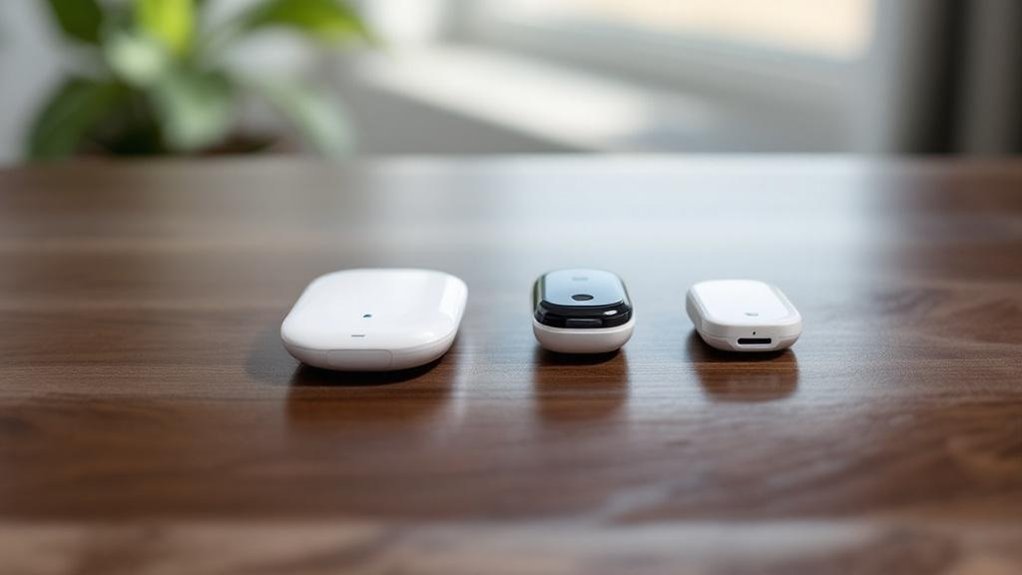
The most tangible difference you’ll notice when upgrading to the G7 is its integrated design—the sensor and transmitter combine into a single unit you apply in one step. With the G6, you’ll insert the sensor first, then snap in a separate transmitter that needs replacing every three months. The G7’s application simplicity means fewer steps and less room for error—just unscrew, apply, and press.
This streamlined approach directly impacts component reliability. The G7 stores 24 hours of data versus the G6’s three hours, reducing gaps during connectivity issues. Without separate parts to align, you’ll eliminate potential connection failures between components. The unified design also means 60% less bulk, making the system more discreet under clothing while maintaining the same 20-foot range we’ve come to expect. The 90-degree insertion angle represents another practical advancement, making application more intuitive compared to the G6’s awkward 30-degree approach.
Accuracy and Real-World Performance: What the Numbers Really Mean
Beyond hardware improvements, you’ll want to understand how these design changes affect measurement accuracy—the metric that ultimately determines your confidence in treatment decisions. The G7 demonstrates 8.2% MARD compared to G6’s 9.0% in controlled studies—approximately 9-12% relative improvement. However, real-world performance reveals more nuance. While accuracy metrics show measurable advancement, user variability introduces complexity. Some users report G7 produces more variable readings during rapid glucose fluctuations, despite better official scores. Both systems exceed the <10% MARD standard for medical devices and maintain clinical reliability within normal ranges. The practical difference? Most treatment decisions remain equally reliable with either generation. The G7’s improvements become most noticeable at extreme glucose levels, where precision matters most for preventing dangerous episodes. Both CGM systems have been proven to improve blood sugar control and lower A1C scores, helping reduce the risk of serious diabetes-related complications.
New Features and User Experience Improvements in G7
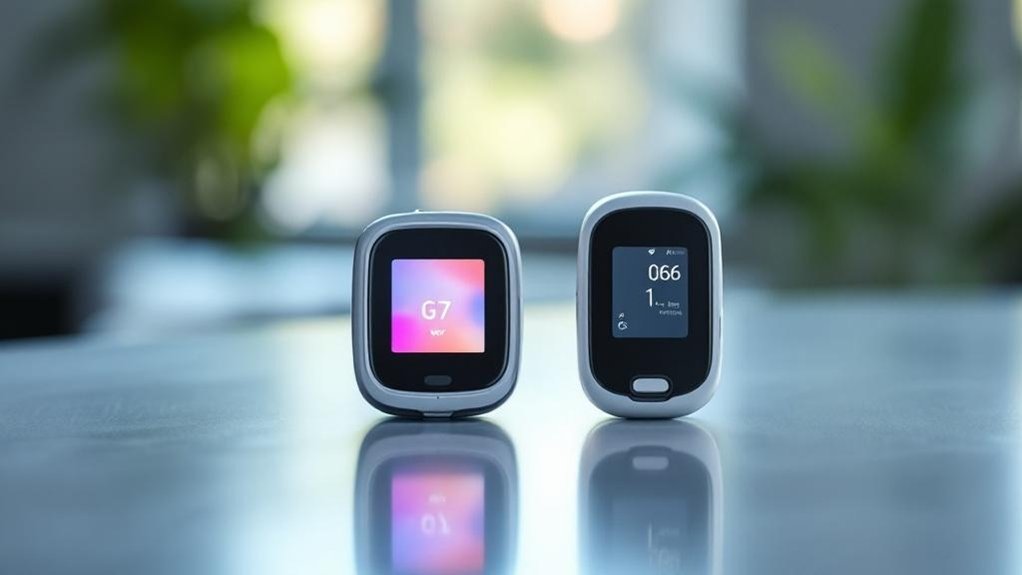
Dexcom’s G7 introduces five fundamental categories of upgrades that collectively transform the daily management experience. The device delivers a 60% smaller profile with waterproof construction and 30-minute warm-up—twice as fast as competing systems. We’ve seen meaningful advances in notification customization, including the Urgent Low Soon Alert that provides 20-minute advance warning, nine sound options, and Silent Mode for up to six hours. The photo-based event logging feature lets you document meals and activities with visual context, while AI-powered Smart Food Log automatically identifies ingredients from your images. Integration capabilities now extend to NovoPen systems and Omnipod 5, creating seamless coordination between glucose monitoring and insulin delivery that helps prevent dangerous insulin stacking. The 7-Day GMI feature now provides an approximate A1C measurement in half the time previously required, giving users faster insight into their glucose trends and encouraging more consistent engagement with the system.
Frequently Asked Questions
Can I Use My G6 Transmitter With G7 Sensors?
No, you can’t use G6 transmitters with G7 sensors due to G6 compatibility issues—they’re completely different systems. However, G7 sensor advantages include faster warm-up, smaller size, and simplified all-in-one design we think you’ll appreciate.
Will My Insurance Cover the Upgrade From G6 to G7?
Coverage depends on your specific insurance policies—many insurers now cover G7, but some haven’t updated their formularies yet. We recommend contacting your provider to verify coverage before starting the upgrade process.
Are G6 and G7 Sensors Interchangeable Between the Two Systems?
No, G6 and G7 sensors aren’t interchangeable due to fundamental system differences affecting sensor compatibility. Each system requires its dedicated components—G6 sensors only work with G6 receivers and apps, while G7 needs G7-specific technology.
How Much Does G7 Cost Compared to G6?
The cost comparison shows minimal price differences between systems. G7’s retail runs $520-550 monthly versus G6’s $547, though G7 saves approximately $800 yearly by eliminating separate transmitter purchases required for G6.
Can I Switch Back to G6 if I Don’t Like G7?
Yes, you can switch back to G6 if the G7 features comparison doesn’t meet your needs. We’ve seen user experiences vary, so you’d simply need a G6 prescription and supplies to make the shift back.
Conclusion
We’ve examined the key differences between these two exceptional CGMs, and while the G7 offers meaningful improvements in size, speed, and convenience, the G6 remains a highly capable system. Your decision should reflect your individual priorities—whether that’s cutting-edge features or sticking with proven technology you trust. Consider your insurance coverage, lifestyle needs, and comfort with your current device. There’s no universal “right” answer, only what’s right for you. We’re here to support whatever choice you make.