

CGM technology has evolved considerably since the first FDA approval in 1999. Today’s market features four major manufacturers controlling 99% of the $9.5 billion industry, with annual costs ranging from $2,000 to $7,000 depending on the system. Newer models like Dexcom G7 offer extended 15-day wear periods and improved accuracy with MARD ratings around 8.2%. Insurance coverage and subscription models are reshaping accessibility, while financial assistance programs help offset these substantial investments.
Key Takeaways
- The first professional CGM was FDA-approved in 1999, while modern consumer devices like Dexcom G7 emerged in the 2020s.
- Annual CGM costs range from under $2,000 for basic systems to approximately $7,000 for premium options.
- FreeStyle Libre systems cost $160-$170 monthly, while Dexcom G6 exceeds $450 monthly without insurance coverage.
- Newer CGM models offer better value with enhanced accuracy and longer wear times despite 5-10% higher pricing.
- Subscription models have emerged to provide predictable pricing, with Nutrisense packages ranging from $151-$224 monthly.
Evolution of CGM Technology Release Timeline
Since their inception in the late 1990s, continuous glucose monitoring systems have undergone remarkable transformation. The journey began with FDA approval of the first professional CGM in 1999, featuring 3-day blind data collection that required healthcare provider downloads for review.
A significant breakthrough came in 2004-2008 when Medtronic introduced the Guardian REAL-Time system with alerts, followed by Dexcom’s STS in 2006 and Abbott’s FreeStyle Navigator in 2008. Modern sensors like the FreeStyle Libre 2 Plus now offer exceptional glucose accuracy with MARD ratings of approximately 8.2%. These technological advancements fundamentally changed user experiences by providing real-time glucose information.
The 2009-2015 era brought mobile integration, while 2016 marked a revolutionary shift with devices eliminating constant finger pricking requirements. The introduction of the FreeStyle Libre Pro required no fingerstick testing during use, making glucose monitoring significantly more comfortable for patients. Today’s CGMs offer multi-day wear with impressive accuracy, and we’re witnessing development toward truly non-invasive solutions that promise to further transform diabetes management.
Comparative Pricing Analysis Across Major CGM Brands
The evolution of CGM technology has been remarkable, but what about their financial impact on patients? Our analysis reveals substantial price variations across leading brands. FreeStyle Libre systems offer the most competitive pricing at $160-$170 monthly ($1,920-$2,040 annually), while Medtronic Guardian Connect commands premium positioning at $240 monthly plus an $800 transmitter. Subscribers can access subscription savings of 10% off regular pricing through FreeStyle Libre’s monthly delivery program.
Sensor lifespan directly drives total ownership costs—FreeStyle Libre’s 14-day sensors require just two replacements monthly, whereas Medtronic’s weekly replacement schedule quadruples consumption. The market spans from under $2,000 to approximately $7,000 annually depending on your chosen system. Dexcom offers accessibility through their Simple Start program for uninsured patients seeking CGM technology.
We’re seeing subscription models emerge as cost-mitigation strategies, with companies like Nutrisense bundling sensors, app access, and professional support into monthly packages ranging from $151-$224.
Insurance Coverage Impact on CGM Affordability
While CGM technology has revolutionized diabetes management, insurance coverage remains the primary determinant of patient affordability. Medicare Part B’s 2025 structure requires patients to meet a $257 deductible before paying 20% coinsurance, with monthly premiums starting at $185. Despite expanded eligibility criteria now including basal insulin users, insurance confusion persists as a significant barrier. Medicare covers several FDA-approved CGMs including Dexcom G6, G7, Abbott Freestyle Libre, and Medtronic Guardian for eligible patients. The Dexcom G6 subscription model offers 10% cost savings through regular monthly deliveries at $296.99.
Coverage disparities between Medicare, Medicaid, and commercial plans create a complex landscape that many patients struggle to navigate. Highmark’s implementation of prior authorization requirements for 2025 exemplifies the increasing hurdles patients face. Even with theoretical coverage, practical access remains challenging due to prior authorization requirements, claim denials, and lack of education about coverage options. These barriers disproportionately affect vulnerable populations, limiting the potential benefits of CGM technology.
Hidden Costs Beyond the Device Purchase
Beyond initial purchase costs, CGM devices introduce a substantial financial commitment that many patients don’t anticipate. We’ve found that healthcare consultations alone create significant hidden expenses, with specialist visits required for prescriptions, renewals, and troubleshooting.
The ongoing supply chain represents another major cost center. Monthly out-of-pocket costs for CGM supplies can range from $160 to $500 without insurance coverage. The Dexcom G7 subscription offers some savings through a 10% discount on monthly supplies. Sensors needing replacement every 10-14 days and transmitters every 3-12 months translate to $1,200-3,600 annually. Many of us face unexpected fees from insurance obligations, including substantial deductibles and coinsurance payments.
Third-party suppliers and retailers add another layer of markup. Even with CGM technology, we still need traditional monitoring supplies, creating duplicate expenses. These compounding costs explain why 31% of us skip monitoring—a concerning reality in our diabetes management community.
Cost-Effectiveness of Newer vs. Older CGM Models
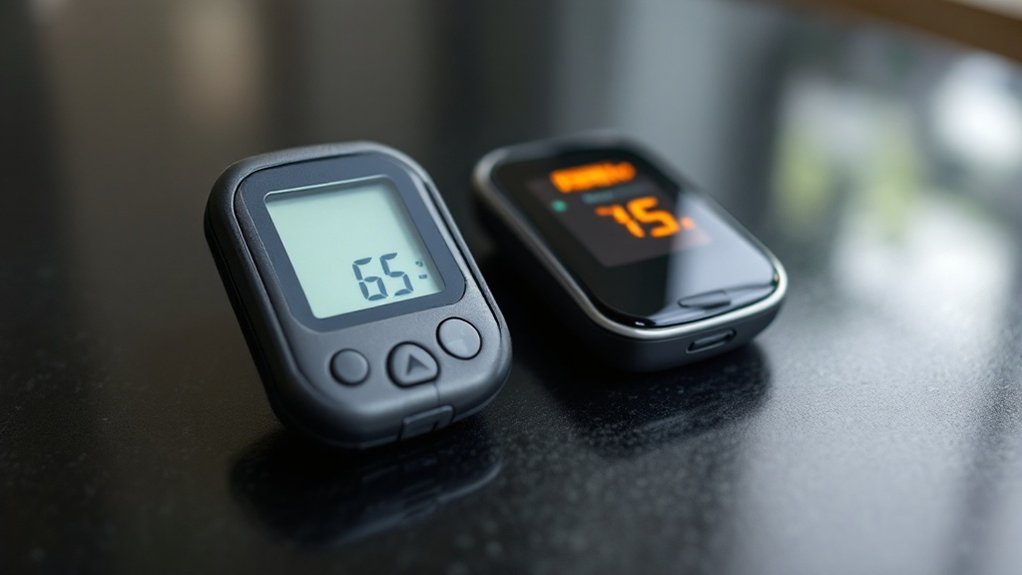
We’re observing a surprising trend where newer CGM models often deliver better value despite similar price points to their predecessors. The latest generation devices typically offer enhanced accuracy, smaller form factors, and smartphone connectivity while maintaining competitive subscription pricing structures that can save users up to $120 annually compared to older models. When comparing long-term costs, newer CGMs with improved sensor longevity and eliminated receiver requirements present a compelling cost-effectiveness case against legacy systems that may appear less expensive initially. With 15-day wear time, modern sensors like the FreeStyle Libre 3 Plus significantly reduce the frequency of sensor changes throughout the year. The Freestyle Libre models stand out as generally the most affordable option for patients seeking cost-effective continuous glucose monitoring solutions.
Generational Price Premium
The notable price differentials between CGM generations reveal complex cost-effectiveness considerations for diabetes patients. Dexcom’s G7 demands a 13% premium ($700 annually) over G6, while FreeStyle Libre bucks the trend with its Libre 3 costing 6% less than Libre 2.
Consumer perception of these pricing structures often hinges on feature improvements rather than accuracy gains, which show diminishing returns across generations. The cost justification for newer models primarily centers on convenience features—G7’s consolidated design eliminates separate transmitters but increases per-sensor costs considerably. These advanced monitoring systems aim to reduce the economic burden of diabetes, which was estimated at $327 billion in 2017 with $237 billion in direct medical costs.
For commercially insured users, coverage variations between generations create different effective costs, with most paying $0-$75 monthly for Libre systems. The value proposition differs dramatically, with annual costs ranging from $1,920 (Libre 3) to $6,000 (Dexcom G7).
Subscription vs. Pay-Per-Device
While generational price differences reveal important trends, payment models represent another critical dimension of CGM affordability. Our analysis shows subscription services like Nutrisense ($151-224/month) bundle multiple sensors with expert guidance, contrasting sharply with traditional Dexcom G6 pay-per-device costs exceeding $450 monthly without insurance.
We’ve observed that subscription benefits extend beyond mere convenience—they provide predictable monthly expenses and eliminate the substantial upfront investment required for transmitters and receivers. This approach particularly serves our community members with high-deductible plans facing significant out-of-pocket expenses.
Device longevity becomes less critical in subscription models, as replacement cycles are managed within the program. For budget-conscious members, Nutrisense’s $39 app-only option presents a hybrid approach, allowing personal sensor procurement while accessing professional analytical support. The recent FDA clearance of over-the-counter CGMs in 2024 may further transform accessibility and pricing structures for non-diabetic users.
Feature-Cost Value Analysis
Evaluating the cost-benefit ratio of continuous glucose monitoring systems reveals considerable disparities between generational models that directly impact our customers’ decision-making process.
When analyzing performance metrics against investment, newer CGMs like Freestyle Libre 3 and Dexcom G7 deliver enhanced accuracy and reduced false alarms for approximately 5-10% higher costs than predecessors. The user experience improvements—including compact sensors, extended wear times, and elimination of separate receivers—often justify this premium for many in our community. Dexcom G7 features customizable alerts that provide an additional safety layer for patients concerned about hypo or hyperglycemia events.
We’ve observed that mid-range options like Medtronic’s systems strike an ideal balance between advanced features and insurance compatibility. Though premium models command higher upfront costs, their improved algorithms and sharing capabilities translate to better glucose management outcomes. For budget-conscious members, older generation devices still provide reliable monitoring at considerably reduced annual expenses.
Financial Assistance Programs for CGM Users

Steering through the financial landscape of Continuous Glucose Monitoring (CGM) systems doesn’t have to overwhelm patients with diabetes, thanks to a robust ecosystem of assistance programs. Numerous financial aid options exist to overcome cost barriers across major manufacturers.
We’ve found that Dexcom offers over 50% savings on monthly supplies, while Eversense provides their 365-day system for as low as $199 annually. Abbott’s MyFreeStyle program may qualify some patients for free sensors. The Subscribe & Save option through Dexcom can reduce costs by an additional 10% off retail pricing.
For broader support, the American Diabetes Association’s Co-Pay Relief Program covers various expenses from testing to insurance premiums. The program addresses systemic health inequities and promotes sustainable change in diabetes care access. Most commercially insured Type 1 patients can access CGMs with minimal out-of-pocket costs, though government insurance recipients face more limited options.
Remember that eligibility requirements vary considerably between programs.
Market Trends Shaping Future CGM Pricing
The continuous glucose monitoring (CGM) market stands at a pivotal inflection point, with several converging forces reshaping future pricing structures. We’re witnessing significant expansion—from $9.5 billion in 2023 to a projected $47.1 billion by 2034—creating economies of scale that should enhance market accessibility. Real-time monitoring has become standard with devices delivering glucose readings every 5 minutes.
Four major manufacturers control 99% of market share, establishing oligopoly dynamics while spurring innovation. Newer devices like Dexcom G7 feature extended 15-day wear periods, improving user experience while reducing per-day costs. The increasing focus on reliable sensor technology has become crucial in driving accuracy and patient satisfaction across all available systems.
Insurance coverage expansion, particularly for Type 2 patients, is democratizing access across North America where market penetration reaches 56.77%.
With 37.3 million Americans managing diabetes, manufacturers can leverage volume-based pricing strategies. Technology improvements—including smartphone integration and wireless connectivity—further eliminate additional equipment costs for patients.
Frequently Asked Questions
How Do Travel Restrictions Affect CGM Supplies and Replacement Procedures?
We’ve seen travel logistics greatly impact CGM supply chain reliability. International regulations vary, X-rays can damage devices, and TSA screening requires special procedures. Always pack double supplies and documentation for your journey.
Can CGM Devices Integrate With Popular Fitness Apps and Wearables?
Yes, CGM devices integrate with major fitness apps and wearables. We’re seeing extensive wearable compatibility across Apple, Fitbit, Samsung, and Garmin platforms, bringing glucose data together with your other health metrics you track daily.
What Is the Environmental Impact of Disposable CGM Components?
Disposable CGM components greatly impact our environment. We’re analyzing manufacturer adoption of sustainable materials and recycling programs to mitigate the substantial plastic waste and carbon emissions generated through our community’s diabetes management tools.
How Do CGM Accuracy Ratings Compare in Real-World Versus Clinical Settings?
We’ve found CGMs maintain decent accuracy across settings, with MARD ranging from 7.9-13.7% in real-world performance versus tighter values in clinical trials. The difference becomes more pronounced during hypoglycemic events.
Are There Special Considerations for CGM Use During Pregnancy?
We’ve found CGM offers significant benefits during pregnancy. It identifies nocturnal hypoglycemia and helps maintain the 63-140 mg/dL target range essential for women with gestational diabetes, potentially reducing neonatal complications.
Conclusion
We’ve documented how the CGM market continues evolving with predictable release patterns and gradual price adjustments. Our analysis indicates insurance coverage remains the primary affordability factor, with a 30-40% cost differential between covered and non-covered devices. As manufacturers compete for market share, we anticipate modest price compression by Q3 2023. For ideal value, we recommend evaluating total ownership costs rather than focusing solely on acquisition price.