

When choosing between Dexcom G7 and FreeStyle Libre 3, consider your specific needs. G7 offers slightly longer wear (15 days vs 14), more placement options, superior water resistance, and advanced predictive alerts. Libre 3 has marginally better accuracy (7.9% vs 8.2% MARD), smaller size, more frequent data transmission, and typically lower cost. Your lifestyle, insurance coverage, and whether you prefer more robust alerts will guide your ideal choice.
Key Takeaways
- Dexcom G7 offers predictive alerts and more placement options, while Libre 3 has a smaller profile and transmits data more frequently.
- Libre 3 is typically less expensive with sensors under $40 versus Dexcom G7 starting at $89 monthly for uninsured patients.
- Dexcom G7 has superior water resistance (8 feet for 24 hours) compared to Libre 3 (3 feet for 30 minutes).
- Dexcom G7 lasts 15 days plus a grace period, while Libre 3 lasts 14 days without a grace period.
- Both systems have similar accuracy (Libre 3: 7.9% MARD; Dexcom G7: 8.2% MARD) but different alert capabilities.
Sensor Accuracy and Real-World Performance

When comparing the Dexcom G7 and FreeStyle Libre 3 continuous glucose monitoring systems, accuracy stands as one of the most critical factors for effective diabetes management. Both systems deliver impressive MARD scores, with FreeStyle Libre 3 reporting 7.9% and Dexcom G7 at 8.2% in some studies, though results vary across research.
The Libre 3 excels with minimal warm-up time and immediate accuracy, requiring no sensor calibration. Meanwhile, Dexcom G7 may benefit from occasional fingerstick calibration during early sensor life. Neither system can fully replace fingerprick tests when readings don’t match symptoms. Additionally, the Dexcom G7 All-in-One Sensor and Transmitter is designed for users aged 2 and up, making it suitable for a wide range of patients.
Both systems reliably track glucose variability, including post-meal spikes and trends. The Libre 3’s 14-day wear period compares to Dexcom G7’s 15 days plus a 12-hour grace period, giving you slightly more coverage before needing a sensor change.
Wearable Design: Size, Comfort, and Durability
Physical comfort and discretion remain essential considerations for continuous glucose monitoring systems that users wear 24/7. In our wearability comparison, the FreeStyle Libre 3 offers a slightly smaller profile—roughly the size of two stacked pennies—compared to the Dexcom G7‘s slightly larger dimensions. Both sensors prioritize comfort factors with lightweight designs, though the Libre 3’s more compact form may provide a marginal edge in day-to-day comfort. For active lifestyles, the G7 offers superior water resistance (8 feet for 24 hours versus Libre 3’s 3 feet for 30 minutes). The Libre 3 weighs slightly less at 0.035 ounces compared to the G7’s 0.039 ounces, which might be noticeable during extended wear. Additionally, the G7’s all-in-one sensor and transmitter design enhances ease of use, making it a convenient option for those managing diabetes.
The G7 provides greater placement flexibility with options for abdomen, upper arm, and upper buttocks (for younger users), while the Libre 3 is limited to the upper arm, which may impact your personal comfort preferences.
Sensor Lifespan and Replacement Considerations
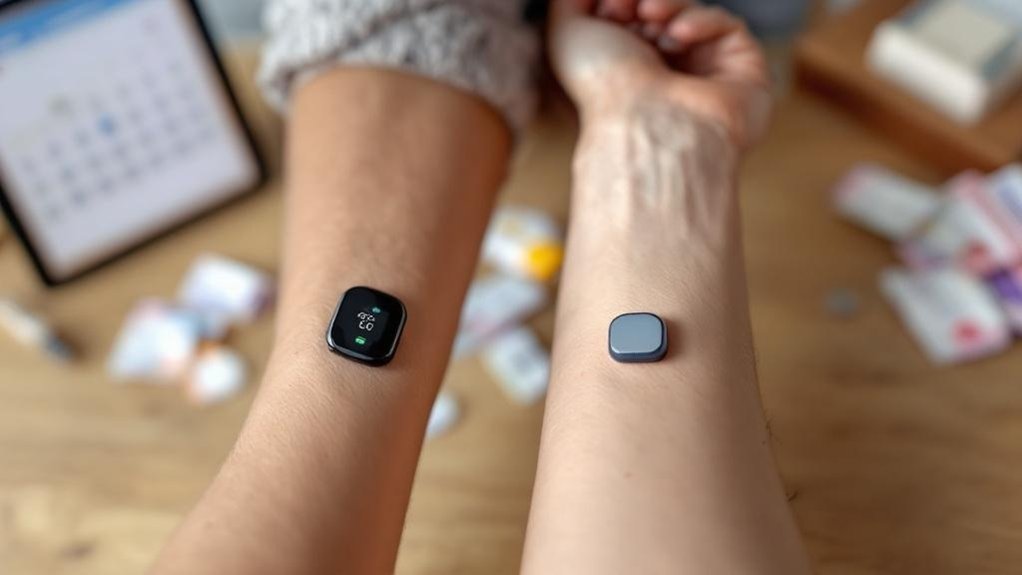
Beyond the physical form and comfort of these devices, a key factor in your continuous glucose monitoring experience is how long each sensor lasts before requiring replacement.
The Dexcom G7 offers superior sensor longevity, lasting up to 15 days with a unique 12-hour grace period that gives you flexibility in replacement timing without losing data. It also activates faster, requiring only 30 minutes of warm-up time versus Libre 3’s 60 minutes. Additionally, the G7’s real-time glucose readings every 5 minutes provide timely insights into your glucose levels.
In contrast, the FreeStyle Libre 3 lasts 14 days with no grace period, requiring precise replacement scheduling. Additionally, the G7’s enhanced water resistance (8 feet for 24 hours) compared to Libre 3’s more limited protection (3.2 feet for 30 minutes) may reduce premature replacements from water damage. The Dexcom G7 has consistently demonstrated better accuracy metrics, with a MARD of 8.2% compared to FreeStyle Libre 3’s 8.9%.
Planning your sensor changes wisely helps maintain continuous monitoring without interruption.
Data Transmission Technology and Connection Reliability
The reliability of glucose data transmission forms a critical foundation for effective diabetes management, affecting how quickly and consistently you receive essential information about your blood sugar levels.
The FreeStyle Libre 3 transmits readings every minute with a range of up to 33 feet, compared to Dexcom G7‘s five-minute intervals and 20-foot range. While Libre 3 requires a smartphone, Dexcom G7 works with both smartphones and dedicated receivers, offering flexibility for your preferred setup. The Dexcom G6 Receiver, known for its continuous glucose monitoring, enhances the user experience by providing real-time data without the need for a smartphone.
Both systems store data when out of range—Dexcom G7 for 24 hours and Libre 3 for the full 14-day sensor life. The FreeStyle Libre 3’s impressive 14-day sensor lifespan offers users extended monitoring without frequent replacements. Your lifestyle needs will determine whether Libre 3’s more frequent updates or Dexcom G7’s proven connection reliability better supports your diabetes management journey.
Alert Systems and Hypoglycemia Protection

Effective alert systems play an essential role in preventing dangerous blood sugar events, especially when you’re managing diabetes with continuous glucose monitoring (CGM).
The Dexcom G7 offers superior alert personalization with high/low, predictive, and rate-of-change notifications. Its predictive Urgent Low Soon Alert can warn you up to 20 minutes before severe hypoglycemia occurs, allowing earlier intervention. You’ll appreciate the “Delay 1st High Alert” feature that reduces alert fatigue. Dexcom G7 also produces fewer false alerts for hypoglycemia than Libre 3+, with only 13% in adults compared to Libre’s 15%. Additionally, the Dexcom G6 Transmitter operates for up to 90 days, providing reliable long-term glucose monitoring.
In contrast, FreeStyle Libre 3 provides only basic high/low alerts without predictive capabilities. While it updates glucose values every minute (versus G7’s 5-minute intervals), Libre 3 lacks volume control for alerts—particularly problematic for iPhone users—and can’t anticipate dangerous lows before they happen, potentially delaying treatment when you need it most.
Smartphone Integration and Data Sharing Capabilities
When managing diabetes effectively, smartphone integration and data sharing capabilities greatly impact your daily experience with continuous glucose monitoring. Both systems offer iOS and Android app functionality, but with notable differences in user experience.
Dexcom G7 transmits data every 5 minutes and allows sharing with up to three devices simultaneously, including Apple Watch integration. Its Follow app enables real-time remote monitoring for caregivers, creating a supportive network for your diabetes management. The Dexcom G7 also features customizable alerts for high or low glucose levels, enhancing user safety and management.
FreeStyle Libre 3 updates more frequently (every minute) but typically connects to only one device at a time. While it offers LibreView cloud sharing, its real-time monitoring capabilities are more limited than Dexcom’s ecosystem. The Libre 3’s smaller sensor size makes it more discreet and comfortable for extended wear periods.
For those using insulin pumps, Dexcom G7’s wider integration with systems like Tandem t:slim X2 provides a more thorough technology solution.
Cost Analysis and Insurance Coverage Options
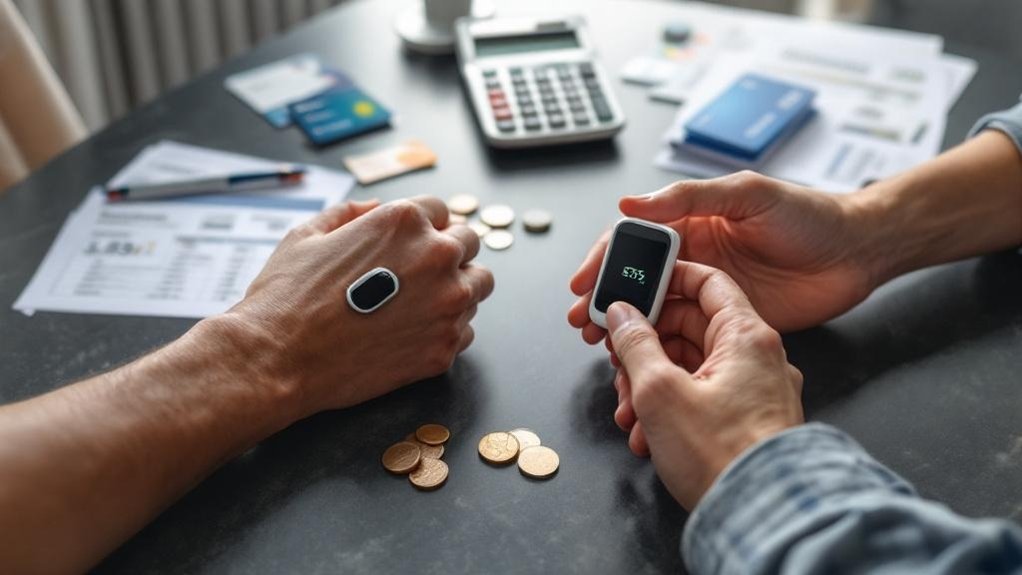
Managing diabetes effectively requires considering both clinical effectiveness and financial sustainability when choosing a continuous glucose monitoring system. When comparing costs, FreeStyle Libre 3 generally offers lower out-of-pocket expenses, with sensors typically under $40 for commercially insured users and a longer 14-day wear time reducing monthly replacement frequency. Additionally, the FreeStyle Libre 3 Plus Sensor has a 15-day wear time, further minimizing sensor changes and related costs.
Dexcom G7 starts at $89 monthly through their Simple Start program for uninsured patients, with pharmacy savings potentially exceeding $200 monthly. Both systems are covered by Medicare, Medicaid, and most commercial plans, though insurance eligibility varies by specific plan.
For the budget-conscious, consider both initial costs and long-term expenses—Libre 3’s longer sensor life (14-15 days versus Dexcom’s 10 days) can greatly impact your monthly diabetes management budget, especially if paying without insurance coverage. FreeStyle Libre 3 also offers a valuable Free Trial Program for commercially insured or cash-paying individuals wanting to test the system before committing financially.
Frequently Asked Questions
Can I Swim or Shower While Wearing These CGM Sensors?
Yes, you can swim and shower while wearing CGM sensors. Both have water resistance ratings—Dexcom up to 8 feet, Libre up to 1 meter. Consider using adhesive covers to prevent skin irritation when wet.
How Painful Is Sensor Insertion for Each Device?
Both CGM sensors offer minimal insertion pain when proper technique is used. FreeStyle Libre 3 typically causes less discomfort with its smaller needle, while Dexcom G7 may occasionally cause more sensor comfort issues.
Are These CGMS Compatible With Insulin Pumps for Automated Delivery?
Dexcom G7 offers extensive insulin pump compatibility for automated delivery systems, integrating with Tandem t:slim X2 and iLet Bionic Pancreas. FreeStyle Libre 3 currently lacks direct AID integration but may support some systems by 2025.
Can Children or Pregnant Women Use These CGM Systems Safely?
Yes, both CGMs are safe for children and pregnant women with specific age restrictions. Dexcom G7 is approved for ages 2+ and pregnancy, while FreeStyle Libre 3 follows similar safety guidelines for ages 4+.
How Do These CGMS Perform at High Altitude or During Air Travel?
Both CGMs function reliably during air travel with minimal altitude effects. You’ll experience continued monitoring, though you may notice temporary connectivity interruptions when your device is in airplane mode.
Conclusion
Ultimately, your choice between Dexcom G7 and FreeStyle Libre 3 depends on your specific diabetes management needs. Consider what’s most important for you—whether it’s real-time alerts, integration capabilities, sensor size, or cost. Both systems offer significant improvements over traditional monitoring methods. Discuss these options with your healthcare provider to determine which CGM will best support your glucose management goals and lifestyle requirements.