

We’ve found that fine-gauge lancets (30G-33G) and standard gauges (28G) show no significant pain differences in clinical studies—comfort depends more on your device’s depth settings and design than needle thickness alone. While 28G lancets penetrate thicker skin effectively and yield larger blood samples, 30G-33G options work well for sensitive skin when paired with shallow 0.6-0.7mm depths. Since modern glucose meters need only 0.3-0.6 microliters, you’ll want to match your lancet gauge to your skin type and meter requirements through systematic trial testing to discover your ideal combination.
Key Takeaways
- Fine-gauge lancets (30G-33G) are thinner and generally preferred for sensitive skin, while standard gauges (28G) suit thicker skin.
- Studies show no significant pain difference between gauges; device design and depth settings impact comfort more than gauge alone.
- Modern meters need only 0.3-0.6 microliters, allowing shallower punctures with fine-gauge lancets to reduce pain while maintaining accuracy.
- Shallow penetration (0.6-0.7mm) with 31G-33G lancets targets capillaries while avoiding deeper nerves, minimizing pain for sensitive individuals.
- Systematic testing starting with 30G-31G lancets helps identify your optimal gauge based on pain levels, blood volume, and skin characteristics.
Decoding the Gauge Number System: Why Higher Numbers Mean Thinner Needles
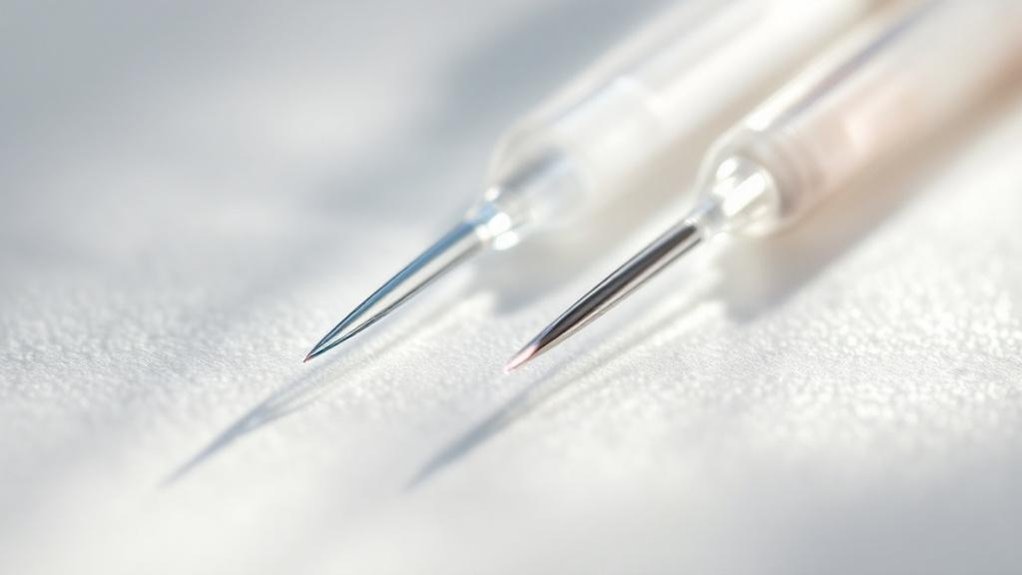
When you’re selecting a lancet, the gauge number serves as your primary indicator of needle thickness—but the relationship works inversely to what you might expect. Higher gauge numbers actually correspond to thinner needles. A 30G lancet measures approximately 0.30 mm in diameter, while a 28G measures 0.35 mm—making the 30G the finer option.
This standardized measurement system applies consistently across all medical needle design worldwide. Understanding gauge history helps clarify why this matters: early lancets used 23G and 25G sizes, but modern manufacturing has shifted toward 28G or higher gauges. Today’s standard diabetic lancets typically range from 28G to 33G.
You’ll find the gauge clearly marked on your lancet packaging with the number followed by “G.” This precision in labeling guarantees you’re always selecting the exact thickness you need. While thinner 30G lancets cause less pain, they may require gentle squeezing to produce an adequate blood sample for testing.
How Needle Thickness Affects Your Testing Experience
Understanding gauge numbers gives you the foundation—now let’s examine how that thickness directly impacts what you’ll feel and experience during each finger stick.
Thicker 28G needles penetrate calloused or tough skin more effectively, producing larger blood samples that eliminate squeezing. They’re ideal if you have seasonal skin changes or work with your hands. Thinner 30G-33G needles offer gentler punctures for sensitive skin, though they yield smaller droplets requiring refined lancing technique.
Modern needle design enhances comfort through bevel-cut edges reducing tissue resistance and silicone coatings smoothing insertion. Precision-guided mechanisms minimize side-to-side movement during puncture.
Your best thickness depends on your skin type and sample requirements. Finding the right gauge may involve trial and error, as personal preferences and sensitivities vary among users. We’re here to help you match the right gauge to your specific needs, ensuring comfortable, effective testing every time.
Pain Perception Across Different Gauge Sizes
We’ve examined how gauge sizes differ in thickness, but what about the pain you actually feel during testing? Research shows that commonly used lancet sizes—28G, 30G, and 33G—produce no statistically significant differences in pain perception, despite what marketing claims might suggest. The comfort of your daily finger sticks depends far more on how nerve endings respond to your specific device design and depth settings than on whether you’re using a 30G or 33G lancet. In clinical studies comparing lancing devices, pain assessments were measured using a visual analogue scale to quantify subjects’ experiences across different testing conditions.
Nerve Stimulation and Thickness
Though lancet thickness might seem like a straightforward factor in pain perception, the relationship between gauge size and discomfort proves more nuanced than we’d expect. Research shows 28G, 30G, and 33G lancets produce no statistically significant difference in overall pain levels. What matters more is how deeply we penetrate. When lancets exceed 2mm depth, they reach nerve pathways that trigger sharper sensation intensity. Conversely, superficial punctures in the upper dermal plexus activate fewer pain receptors, allowing us to better distinguish comfort levels. Device engineering—like vibration reduction and lateral motion control—consistently outweighs gauge selection in determining pain. Notably, patients with thin and normal skin experience higher pain intensity compared to those with thicker skin types. That’s why we focus on finding the right device-and-depth combination for your unique skin condition and pain tolerance, ensuring reliable blood samples without unnecessary discomfort.
Daily Testing Comfort Factors
When we examine clinical data on gauge-specific pain perception, the evidence reveals unexpected patterns that challenge conventional assumptions about lancet thickness. A thorough 90-participant study found no significant pain differences across 28G-33G lancets (P=0.4966), suggesting that patient experiences depend more on device mechanics than gauge alone. However, isolated testing with 33G lancets showed dramatically lower pain scores—42.6mm reduction on visual analog scales (P=0.0004)—with 100% of participants reporting zero pain using 0.15mm diameter lancets. These findings inform practical comfort strategies: while ultra-fine gauges like 33G offer proven benefits for sensitive individuals, the lancing device itself and depth settings ultimately determine daily testing comfort. The shallow penetration depth of 0.6-0.7mm specifically targets capillaries in the superficial dermis while avoiding deeper nerve fibers that contribute to pain perception. We recommend pairing finer gauges with quality devices optimized for gentle penetration.
Individual Pain Threshold Variations
Understanding gauge-specific comfort allows us to examine how individual biology shapes the lancing experience. While studies across 90 participants showed no statistically significant pain differences between 28G, 30G, and 33G lancets overall, individual differences create highly personalized responses. Your unique pain perception depends on skin thickness, nerve distribution, and sensitivity thresholds that vary substantially from person to person.
What’s remarkable is how fine-gauge lancets (33G) consistently minimize discomfort across these individual variations. In controlled studies, 100% of participants reported zero pain with 0.15mm diameter lancets, compared to only 5.40% achieving the same comfort with standard gauges. This consistency suggests that while we each experience pain differently, ultra-fine gauges effectively work within everyone’s tolerance range, making them our most reliable option for comfortable testing.
Blood Volume Requirements for Accurate Glucose Monitoring
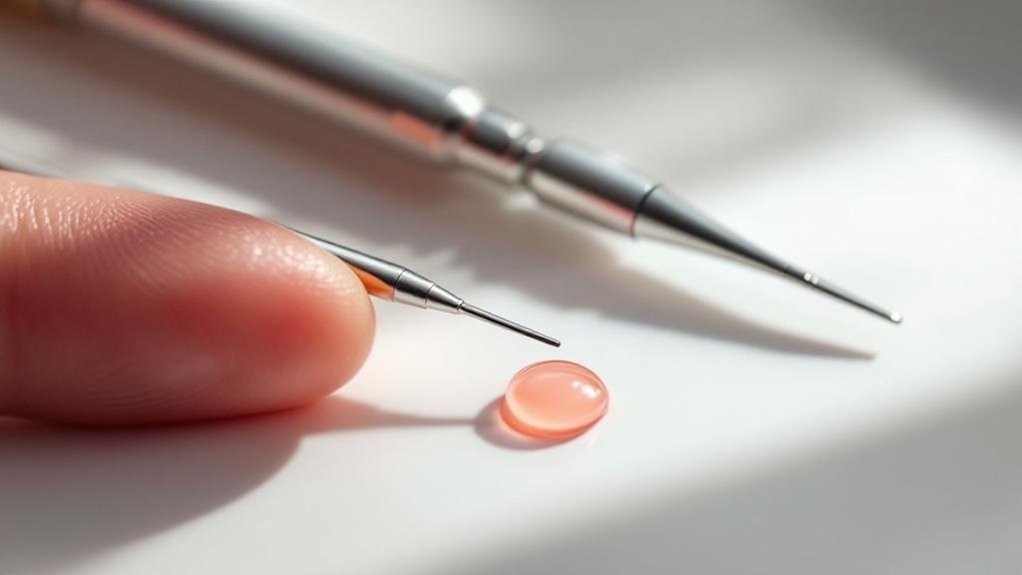
While we’ve discussed comfort, we also need to guarantee each finger prick produces enough blood for an accurate reading. Modern glucose meters require surprisingly small sample volumes—typically 0.3 to 0.6 microliters—but your lancet gauge and depth setting directly determine whether you’ll meet that minimum threshold. Understanding how these variables affect blood yield helps you avoid the frustration of insufficient samples and repeated finger sticks. If you’re experiencing repeated access issues with your testing device, verify your access settings to ensure proper functionality and prevent testing delays.
Minimum Sample Size Standards
Blood glucose meters require specific minimum sample volumes to deliver accurate readings, and these requirements vary considerably across devices. While ISO 15197:2013 establishes accuracy standards, it doesn’t mandate universal sample volume specifications. Each manufacturer determines their own minimum requirements—for example, the Abbott FreeStyle Precision Pro specifies 0.6 µL. However, professional organizations recommend selecting meters with sample volume requirements of ≤0.4 µL, which reduces discomfort during blood collection and improves patient adherence.
Understanding these standard requirements matters because accuracy only applies when you provide the manufacturer-specified minimum. Insufficient samples typically trigger error messages rather than displaying inaccurate results. When choosing lancets, we recommend considering your meter’s specific sample volume needs—devices requiring smaller volumes allow shallower, less painful punctures while maintaining measurement precision. Factors such as reagent type can also affect measurement results, making it important to understand your specific device’s characteristics.
Gauge Impact on Yield
Your meter’s accuracy depends on collecting enough blood—and lancet gauge directly determines how much you’ll get from each finger stick.
We’ve documented clear differences through clinical testing. Standard 28G lancets consistently produce the highest blood volumes, making them ideal when your meter requires larger samples. Moving to 30G reduces yield but still provides sufficient blood for most monitors. At 33G, you’ll notice smaller droplets that demand precise technique. Even ultra-fine 38G lancets—our thinnest option—deliver approximately 1.0 microliter, enough for modern meters with minimal sample requirements.
The hierarchy remains consistent: thinner needles mean less blood. Your gauge selection becomes vital if you’re experiencing insufficient sample errors. We recommend matching your lancet to your meter’s specifications, ensuring reliable results without unnecessary re-testing. Proper disposal of used lancets is essential for maintaining hygiene and preventing infection risk after each blood glucose test.
Meter-Specific Blood Requirements
Getting enough blood matters little if your meter can’t work with what you’ve collected. Each monitoring system has specific minimum volume requirements that directly impact meter accuracy. We need to match our lancet choice to our device’s demands.
Modern meters typically require 0.3 to 1.5 microliters of blood. Systems like CONTOUR®NEXT ONE feature Second-Chance® sampling, letting us apply more blood to the same strip if the initial sample falls short. This maintains sample consistency without wasting supplies.
When blood volume proves insufficient, meters may display error messages or produce unreliable readings that don’t meet ISO 15197 standards. That’s why we should verify our meter’s requirements before selecting lancet gauges. Knowing these specifications helps us achieve accurate results consistently while minimizing discomfort. Some advanced systems can measure other analytes like ketones when paired with different reagent strips, expanding their diagnostic capabilities beyond glucose monitoring alone.
Matching Lancet Gauges to Your Lancing Device
While selecting the right gauge matters for comfort, choosing a lancet that actually fits your lancing device is equally critical. Not all lancets work with all devices—some systems are proprietary, requiring brand-specific lancets. For example, OneTouch Delica only accepts OneTouch Delica lancets, while Accu-Chek products need Softclix, Multiclix, or Universal lancets. Fortunately, many devices offer universal lancing device compatibility, accepting most standard round-tipped lancets regardless of brand.
We recommend checking your device’s specifications before purchasing lancets. Look for gauge sensitivity requirements—some devices accept 28-30 gauge ranges, while others specify exact gauges like 33. Physical characteristics matter too: cylindrical shape and tip design affect proper fitting. Your device’s user documentation will list compatible lancets, preventing malfunctions and ensuring proper blood extraction every time. Some lancing devices feature silicon-coated needles that glide more smoothly through the skin, making the testing process easier and more comfortable for users.
Choosing the Right Gauge for Your Skin Type
Beyond device compatibility, selecting the appropriate lancet gauge depends largely on your individual skin characteristics. If you have thin or sensitive skin that bruises easily, we recommend 31G-33G lancets combined with shallow depth settings (1-2). These lancing techniques minimize discomfort while still producing adequate blood samples. For those with thick or calloused skin, 25G-28G lancets with deeper penetration settings (5+) guarantee reliable blood flow. Clinical evidence shows that thin and normal skin types experience higher pain intensity during sampling, making proper gauge selection critical for your comfort. Most people with average skin sensitivity find 28G-30G lancets ideal at mid-range depth settings (3-4). The gauge number system works inversely, where higher gauge numbers indicate thinner needles that typically cause less discomfort during puncture. Understanding your skin type helps you optimize both sample quality and comfort during testing.
The 28G vs. 30G vs. 33G Comparison
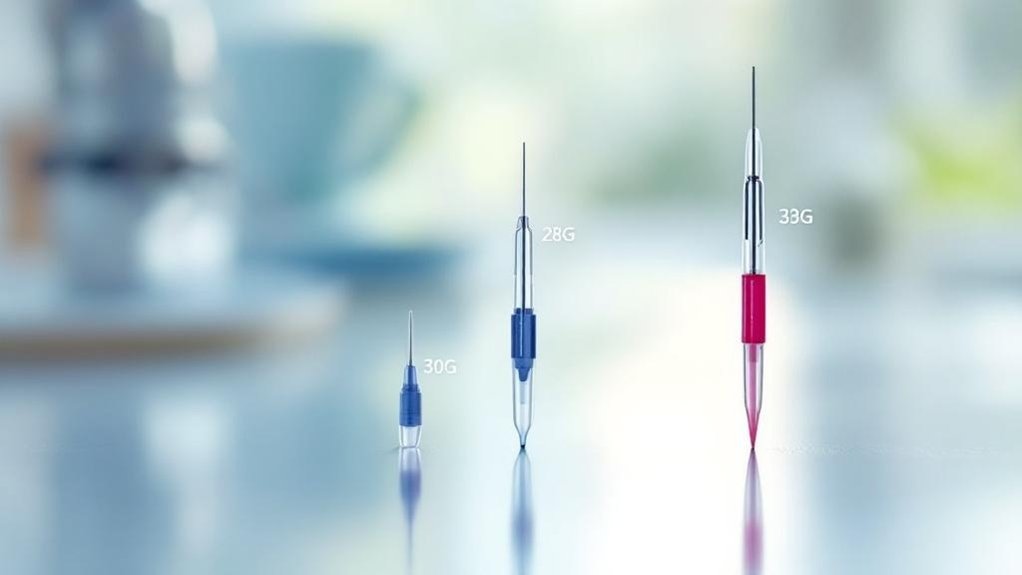
Three common lancet gauges—28G, 30G, and 33G—dominate today’s diabetes testing market, each offering distinct advantages for different patient needs.
The 28G gauge (0.35mm diameter) produces reliable blood samples, making it ideal when your meter requires larger volumes. The 30G option (0.3mm) balances comfort with adequate sample collection—we find it’s the sweet spot for most daily testing routines. The finest 33G gauge (0.2mm) minimizes tissue disruption, though you’ll sometimes need extra pressure to obtain sufficient blood.
Modern lancet designs incorporate tri-beveled needle materials that enhance comfort across all gauges. While thinner needles theoretically cause less discomfort, clinical studies show device quality affects pain more than gauge selection. We recommend choosing based on your meter’s blood requirements and personal comfort preferences.
Children typically benefit from the 33G option due to their thinner skin composition, which responds well to higher gauge needles that minimize discomfort during testing.
Optimizing Comfort With Adjustable Depth Settings
Selecting the right gauge matters less when your lancing device lacks proper depth control. We recommend starting with the shallowest setting—typically 1.3mm—and incrementally adjusting until you achieve sufficient blood volume. This methodical approach to depth customization minimizes discomfort while maintaining functionality.
Most devices offer three standard settings: 1.3mm, 1.8mm, and 2.3mm. Penetration beyond 2mm reaches nerve layers, causing considerably more intense pain sensations. Studies confirm that devices with greater depth differentials (1.20-1.50mm) show measurable blood volume differences between settings, while smaller differentials (0.80mm) demonstrate no considerable variation.
Your adjustment techniques should account for individual skin thickness and testing site. Secure clicking mechanisms prevent accidental changes during use. We’ve found that combining proper depth settings with fine-gauge needles enables nearly pain-free sampling for our community. The ultrafine tri bevel tip design facilitates easier skin penetration while reducing tissue trauma during the puncture process.
Finding Your Personal Sweet Spot Through Trial Testing
Why does the same lancet gauge produce vastly different results for different people? Individual skin thickness, callous formation, and pain sensitivity create unique physiological profiles that demand personalized solutions. We recommend implementing systematic trial testing to identify your ideal gauge.
Start with finer gauges (30G-31G), rotating between different finger sites while maintaining consistent environmental conditions. Document trial outcomes meticulously: pain intensity, blood volume sufficiency, and residual discomfort duration. Allow 24-hour recovery between different gauge sessions to guarantee accurate user feedback.
Your sweet spot emerges when you consistently achieve adequate blood samples without excessive finger squeezing, minimal visible skin damage, and willingness to repeat the procedure without hesitation. This iterative refinement process, supported by detailed metric recording, enables enhancement toward your personalized comfort solution. Remember that comfort will increase with practice, as repeated testing naturally desensitizes the fear response over time.
Frequently Asked Questions
Can I Reuse Lancets if I’m the Only Person Using Them?
We don’t recommend reusing lancets, even for single-person use. Proper lancet hygiene prevents infection, while fresh lancets minimize puncture pain since they dull quickly. Replace after each use for safest, most comfortable testing.
Do Lancets Expire and How Should I Store Them Properly?
Yes, lancets expire—typically 1-2 years from manufacturing. We recommend checking the lancet shelf life before each use. For proper storage, keep them sealed at room temperature, away from sunlight, heat, and humidity.
Are Colored Lancets Different From Regular Silver-Colored Lancets Medically?
No, colored lancet effectiveness equals silver lancets—color only indicates gauge size or flow model. Silver lancet safety remains identical to colored versions. We recommend selecting based on gauge number for your comfort needs, not color.
Can I Use Lancets From One Brand in a Different Manufacturer’s Device?
Lancet compatibility depends on brand differences in gauge, base design, and device specifications. We recommend checking your lancing device’s requirements first. Universal devices offer flexibility, while manufacturer-specific systems need matched lancets for ideal safety and comfort.
Does Insurance or Medicare Cover the Cost of Replacement Lancets?
Medicare policies cover replacement lancets under Part B with 20% coinsurance after deductible. We’ll help you understand insurance coverage limits—300 lancets quarterly for insulin users, 100 for non-insulin users—and reimbursement documentation requirements.
Conclusion
We’ve explored how gauge numbers, skin types, and device settings all influence your testing comfort. Now it’s time to put this knowledge into practice. Start with a 30G lancet if you’re unsure, then adjust based on your results. Remember to pair your gauge choice with the shallowest depth setting that produces adequate blood volume. Test different combinations systematically, noting what works best. There’s no universal perfect lancet—only the one that’s perfect for you.