

Non-invasive glucose monitoring represents diabetes care’s most transformative advancement. Recent optical technologies using near-infrared spectroscopy achieve 95.6% accuracy, while wearable biosensors deliver continuous readings without fingersticks. Clinical trials show promising results, with GlucoModicum reaching 11.5% MARD accuracy across 646 participants. We’re witnessing integration with digital health ecosystems for personalized treatment. The following developments illustrate how these innovations eliminate pain points while improving glycemic control.
Key Takeaways
- Recent clinical trials show non-invasive glucose monitors achieving 11.5% MARD accuracy in studies with hundreds of participants.
- Wearable biosensors provide continuous glucose readings every minute for up to 14 days without manual calibration.
- Optical technologies like near-infrared spectroscopy now achieve 95.6% accuracy with 5.99% mean absolute percentage error.
- Non-invasive methods eliminate pain, reduce testing anxiety, and significantly improve patient adherence to monitoring regimens.
- Integration with digital health ecosystems enables personalized treatment plans and automated insulin delivery systems.
The Urgent Need for Non-Invasive Diabetes Monitoring
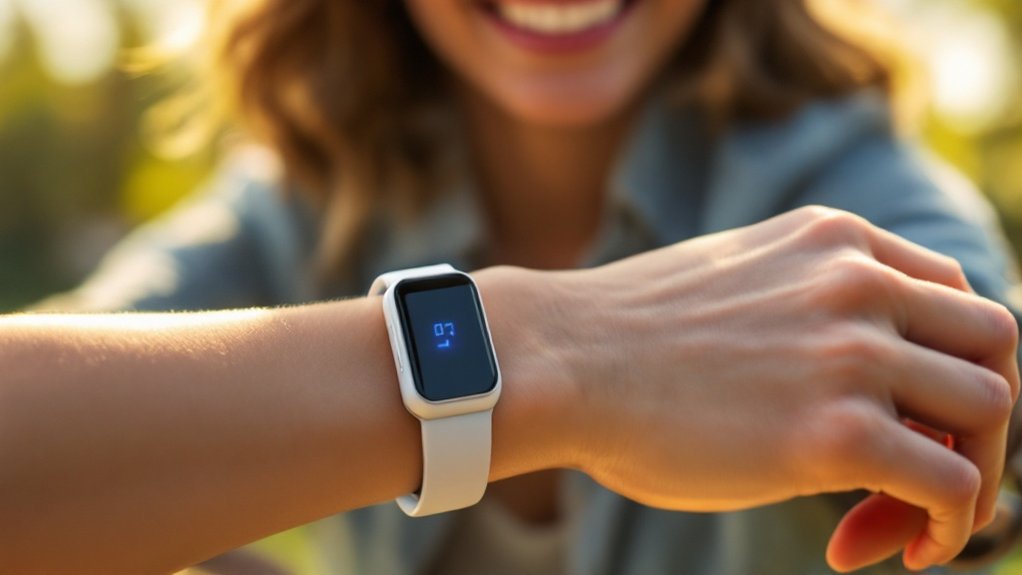
As diabetes continues to spread at alarming rates globally, the imperative for non-invasive glucose monitoring solutions has never been more vital. Traditional fingerstick methods provide only momentary snapshots rather than the continuous data essential for effective management.
We’ve observed that painful monitoring techniques greatly reduce patient adherence to testing regimens. When patients avoid necessary testing due to discomfort, they miss critical glycemic fluctuations that can lead to serious complications including neuropathy and cardiovascular disease. The latest CGM sensors like the FreeStyle Libre 3 deliver real-time glucose readings every minute without requiring any fingerstick calibration.
Non-invasive techniques represent the necessary evolution in diabetes care, addressing both clinical and psychological barriers to consistent monitoring. Devices like the FreeStyle Libre System and Dexcom G7 measure glucose in interstitial fluid and can be worn for up to 14 days, providing continuous readings without the need for painful finger pricks. By eliminating pain and increasing convenience, these methods promise to transform how we collectively manage this metabolic condition, enabling more thorough data collection and timely therapeutic interventions.
Revolutionary Optical Technologies Transforming Glucose Detection
The field of optical glucose sensing has undergone remarkable advancement in recent years, offering promising solutions to the pain and inconvenience associated with traditional blood glucose monitoring. We’re witnessing unprecedented optical advancements that leverage specific wavelengths to interact with glucose molecules in blood vessels.
Near-infrared spectroscopy has achieved 95.6% accuracy with a mere 5.99% mean absolute percentage error. The recently developed system utilizes dual NIR wavelengths of 940 nm and 1050 nm to penetrate skin tissue for precise glucose estimation. Raman spectroscopy’s innovative μ-spatially offset approach targets vessel-rich skin layers for enhanced glucose accuracy. Meanwhile, optical coherence tomography provides depth-resolving capabilities unaffected by physiological variables.
These technologies share our commitment to making diabetes management less intrusive. While challenges remain—including equipment costs and calibration requirements—we’re confident these revolutionary approaches will soon transform how we all experience glucose monitoring.
Wearable Biosensors and Electrochemical Innovations
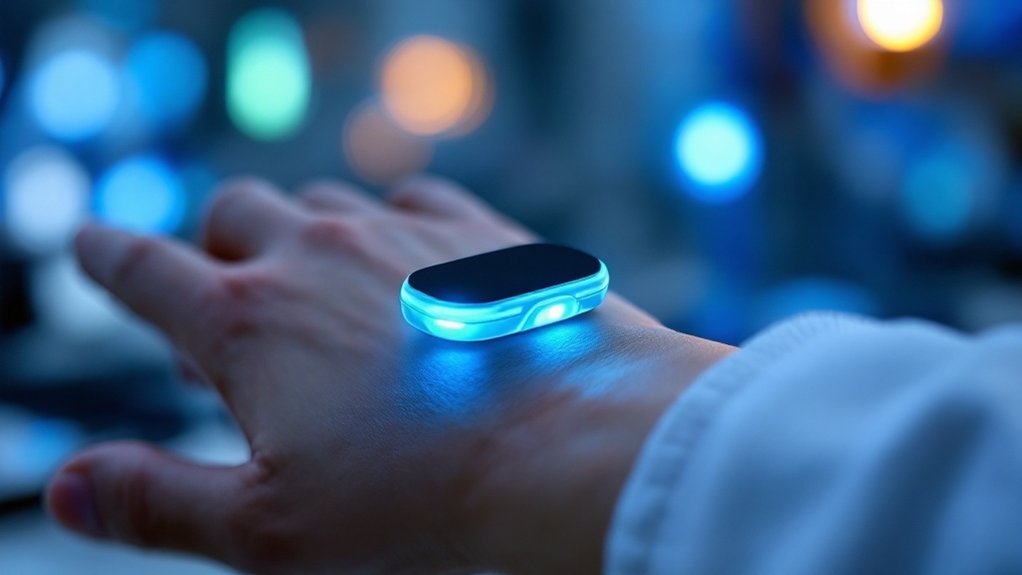
Wearable biosensors represent a revolutionary advancement in glucose monitoring technology, offering patients unprecedented freedom from traditional fingerstick methods. These sophisticated wearable devices integrate electrochemical sensors that continuously measure glucose in interstitial fluid, providing real-time data and alerts through wireless connections to smartphones. The factory-calibrated sensors eliminate the need for manual fingerstick calibrations while delivering glucose readings every minute.
We’re witnessing remarkable progress in non-invasive electrochemical detection methods, where bioreceptors, transducers, and display systems work in harmony. Many systems utilize glucose oxidase enzymes, while newer non-enzymatic approaches overcome limitations related to temperature and pH fluctuations.
The integration of CGM with automated insulin delivery represents a paradigm shift for our community. These platforms can adjust insulin administration based on real-time glucose readings, maintaining more stable levels throughout the day and night—transforming episodic monitoring into continuous, automated diabetes management. Research shows that performance expectancy is the most influential factor driving patient adoption of these wearable insulin biosensor technologies.
Clinical Trial Progress and Regulatory Approval Timeline
Recent breakthroughs in needle-free glucose monitoring have accelerated clinical validation processes, with several innovative technologies approaching final regulatory milestones. We’re witnessing impressive trial outcomes, with GlucoModicum achieving 11.5% MARD accuracy—remarkably close to the 10% industry benchmark—in a 646-participant study.
Regulatory challenges remain, but multiple companies are maneuvering approval pathways strategically. GlucoModicum plans data submission to FIMEA before year-end 2025, while Transdermal Diagnostics has secured £800,000 in funding to advance their technology. Afon Technology’s Glucowear™ wrist-worn device represents six years of dedicated innovation. The innovative Talisman device uses magnetohydrodynamic technology to sample interstitial fluid without penetrating the skin.
We’re at a pivotal moment in diabetes care, where these technologies aren’t just promising theoretical concepts—they’re advancing through clinical validation with defined regulatory timelines, bringing us closer to a needle-free reality.
How Next-Generation Monitoring Will Transform Patient Care
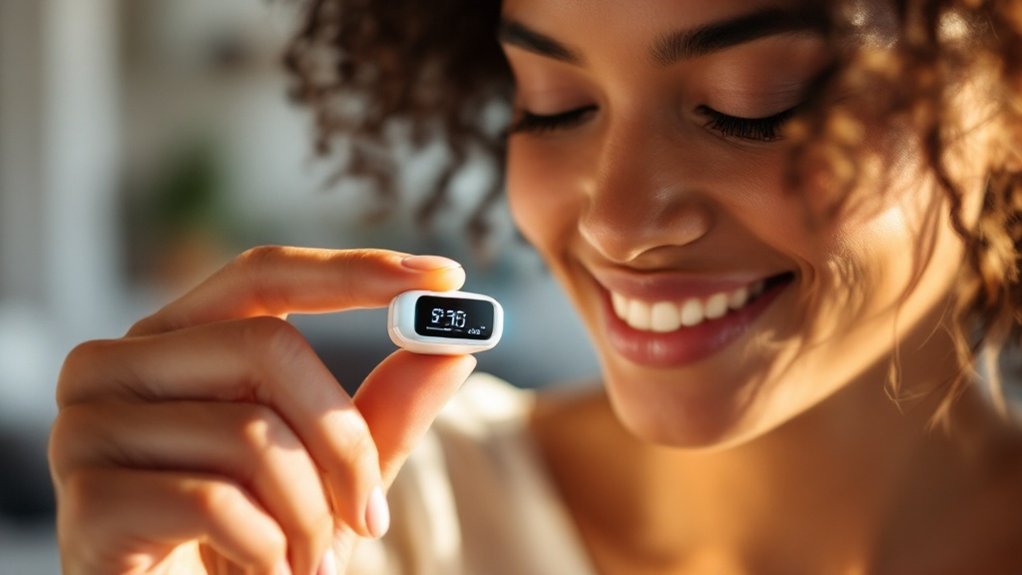
As revolutionary needle-free glucose monitoring technologies advance toward market readiness, we’re witnessing a fundamental transformation in diabetes care delivery that extends far beyond mere convenience.
These innovations—demonstrating 76.6% Zone A accuracy in Clarke Error Grid Analysis—eliminate infection risks while providing immediate glucose estimation. The FreeStyle Libre sensor enables continuous readings every minute for up to 14 days without fingerstick calibration. Wearable electrochemical sensors and ultrathin skin-like biosensors (correlation coefficients >0.9) integrate seamlessly with digital health ecosystems, enabling personalized treatment protocols based on continuous metabolic data.
The pain-free experience addresses historical adherence challenges, while smartphone connectivity transforms standard devices into sophisticated point-of-care analyzers. The significant psychological burden of anxiety and fear associated with traditional blood testing is substantially reduced with these non-invasive methods. We’re moving toward extensive patient empowerment through systems that combine real-time monitoring with automated insulin delivery—truly transforming diabetes from a condition requiring constant intervention into one that’s intelligently managed with minimal disruption.
Frequently Asked Questions
How Affordable Will These New Technologies Be for Average Consumers?
We’re seeing initial non-invasive technologies priced higher than traditional options, but our cost comparison suggests market accessibility will improve as competition increases and manufacturing scales, making them affordable for our community by 2027-2030.
Will Insurance Companies Cover Non-Invasive Glucose Monitoring Devices?
We’re seeing limited insurance coverage policies for non-invasive monitors currently. Most plans require FDA approval and clinical evidence before addressing reimbursement challenges. We’ll help navigate these hurdles together as technology advances.
Can Children and Elderly Patients Easily Use These New Technologies?
Yes, modern glucose monitoring technologies offer user-friendly interfaces suitable for both children and elderly patients. We’ve seen improved accessibility through simplified designs, though some seniors may initially benefit from caregiver assistance during the changeover period.
How Long Will Device Batteries Last Between Charges?
We’ve observed significant battery longevity variations across monitoring devices. Rechargeable CGMs typically last 10-15 days, while newer systems like Eyva provide 10 days between charging. Your specific usage will affect charging frequency.
Are There Any Potential Side Effects From Using Optical Monitoring Methods?
We acknowledge optical accuracy limitations in current needle-free monitoring. Some patients experience skin irritation, while long term effects on metabolic markers require further clinical validation within our diabetes community.
Conclusion
We’re witnessing unprecedented advancement in non-invasive glucose monitoring technologies. Clinical trials demonstrate that optical spectroscopy and electrochemical biosensors achieve accuracy rates approaching 85-95% compared to traditional methods. These platforms greatly reduce HbA1c levels by enabling 5-8 additional daily measurements without pain. As regulatory pathways solidify, we’re approaching a metabolic monitoring paradigm where continuous glycemic assessment becomes seamlessly integrated into patients’ daily routines without disrupting their quality of life.