

We can use our FSA or HSA to save 30-40% on diabetic supplies by purchasing them with pre-tax dollars. Both accounts cover essential items like blood glucose meters, test strips, lancets, continuous glucose monitors, insulin products, and delivery systems—all without requiring a prescription thanks to the CARES Act. FSAs allow up to $3,300 in contributions for 2025, while HSAs offer $4,300 for individuals, with funds rolling over indefinitely. Understanding which supplies qualify and how to time our purchases strategically helps us maximize these valuable tax savings throughout the year.
Key Takeaways
- Diabetic supplies like glucose meters, test strips, lancets, CGMs, and insulin qualify for FSA/HSA reimbursement without requiring a prescription.
- Use your FSA/HSA debit card at purchase to avoid reimbursement paperwork and keep itemized receipts for claims documentation.
- FSA contributions cap at $3,300 in 2025 with limited rollover; HSA allows $4,300 individual or $8,550 family with indefinite rollover.
- Time large equipment purchases during maximum contribution years and stockpile supplies before year-end to avoid forfeiting unused FSA funds.
- HSA offers triple tax advantages and portability, while FSA requires strategic planning due to “use it or lose it” provisions.
Understanding Account Types That Cover Diabetic Supplies
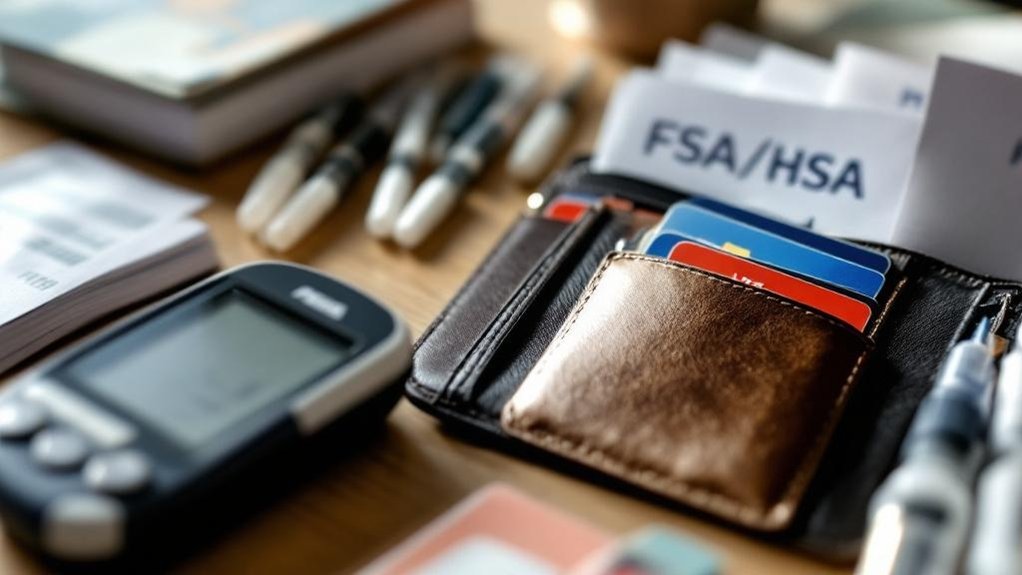
When managing diabetes, understanding which tax-advantaged accounts cover your supplies can translate to significant savings. We’ll help you navigate FSA eligibility, HSA advantages, HRA policies, and LPFSA restrictions so you can maximize your benefits.
Standard FSA covers diabetic supplies through pre-tax payroll deductions under IRS Code Section 213(d). You’ll have immediate access to your elected annual amount, though funds typically follow use-it-or-lose-it rules. Most diabetic supplies require no prescription when purchasing with FSA funds.
HSA offers triple tax advantages for diabetes management when paired with a high-deductible health plan. Your contributions roll over indefinitely, building long-term savings.
HRA provides employer-funded reimbursement for supplies, with coverage terms set by your company’s specific plan design.
LPFSA excludes diabetic supplies but covers dental and vision expenses while preserving HSA eligibility for extensive health management.
Eligible Diabetic Monitoring Equipment and Supplies
The foundation of diabetes management relies on accurate monitoring equipment, and we’re pleased to confirm that your FSA/HSA covers essential tools you use daily. Blood glucose meters, test strips, lancets, and lancing devices all qualify without requiring a prescription, making it straightforward to purchase these necessities with pre-tax dollars. If you’re using a continuous glucose monitor (CGM), that’s covered too—these devices are classified as durable medical equipment, and you’ll also find that control solutions for calibrating your meters are eligible expenses. Keep in mind that IRS-defined qualified expenses may change over time, so it’s worth checking current eligibility periodically.
Blood Glucose Testing Essentials
Blood glucose meters and their accompanying test strips form the foundation of daily diabetes management, and they’re fully eligible for reimbursement through your FSA or HSA—no prescription required. These essential tools use electrochemical technology to convert glucose into measurable electrical current, providing immediate digital readings that guide your treatment decisions.
The testing importance can’t be overstated. If you have Type 1 diabetes, you’ll typically test 4-8 times daily—before and after meals, exercise, and at bedtime. Type 2 diabetes generally requires at least two daily tests. This consistent monitoring helps you identify dangerous highs and lows, plan meals and medications effectively, and track whether your treatment approach is working. Additionally, lancets and lancing devices are necessary components of the testing process for safe blood extraction.
We carry FSA/HSA-eligible supplies from trusted brands including OneTouch, Accu-Chek, FreeStyle, and CareTouch at prices up to 65% below retail.
Continuous Glucose Monitor Coverage
As diabetes technology advances, Continuous Glucose Monitors (CGMs) have transformed daily management by eliminating the need for constant fingersticks—and they’re fully eligible for FSA and HSA reimbursement under IRS Code Section 213(d). Understanding CGM benefits helps you maximize your healthcare dollars while improving glucose control.
Your FSA/HSA covers all CGM types, including standard systems, Bluetooth-enabled devices, and FDA-approved over-the-counter options like Dexcom Stelo and FreeStyle Libre. Replacement sensors and associated components qualify too. We’ve made purchasing simple—use your FSA/HSA card directly at checkout without reimbursement paperwork.
Here’s what matters: while insurance often requires prescriptions for CGM coverage, your FSA/HSA doesn’t. Keep your receipts for plan verification, and remember that devices must have FDA clearance as medical devices rather than general wellness trackers. Pediatric glucose monitors and starter kits are also eligible for purchase with your FSA or HSA funds.
Calibration and Control Solutions
While CGMs offer cutting-edge monitoring technology, traditional blood glucose meters remain the backbone of diabetes management for millions—and keeping those meters accurate requires control solutions.
Control solution benefits are significant: these standardized glucose concentrations verify your meter’s functionality and detect malfunctions that could compromise treatment decisions. They’re essential for initial device setup and periodic performance validation.
Here’s welcome news: control solutions explicitly qualify as FSA/HSA eligible expenses under IRS Code Section 213(d). There’s no prescription requirement, and they’re classified as mandatory monitoring accessories. Using tax-free contributions from your FSA or HSA to purchase control solutions maximizes your savings on these essential diabetes management tools.
When purchasing, verify products are FDA-cleared and specifically marketed for diabetes management. General lab chemicals don’t qualify. Calibration techniques using these solutions protect the accuracy you depend on daily.
Keep detailed receipts showing product descriptions indicating medical use for diabetes management.
Insulin Products and Delivery Systems You Can Purchase
Managing diabetes with insulin requires not only the medication itself but also the right delivery systems to administer it safely and effectively. We’re here to help you understand which insulin types and delivery methods qualify for your FSA or HSA funds.
All insulin products are eligible for reimbursement without a prescription, thanks to the CARES Act. This includes rapid-acting, short-acting, intermediate-acting, and long-acting formulations. Your FSA and HSA also cover essential delivery methods like insulin syringes, insulin pens, and insulin pumps.
Don’t forget the supporting supplies you’ll need: lancets, lancing devices, and sharps disposal containers all qualify for reimbursement. Blood glucose meters are essential for monitoring your levels and tracking how your insulin therapy is working. We provide itemized receipts with every purchase to make your claims process straightforward and stress-free.
Additional Diabetes-Related Items Covered by Your Account

Beyond the testing supplies and insulin products we’ve covered, your FSA/HSA funds can also purchase emergency glucose treatment products like glucose tablets and gels that rapidly raise blood sugar during hypoglycemic episodes. These over-the-counter items are eligible without a prescription because they’re classified as essential medical care for managing low blood sugar emergencies. Additionally, many accounts cover diabetes self-management education services and nutritional counseling when provided by qualified healthcare professionals, helping you develop the skills and knowledge to optimize your daily diabetes care. Your FSA/HSA purchases come with a 100% Eligibility Guarantee, ensuring that all diabetic products meet the requirements for reimbursement from your account.
Emergency Glucose Treatment Products
When your blood sugar drops below safe levels, having fast-acting glucose products readily available can prevent a medical emergency. We’re pleased to share that glucose gel and glucose tablets are fully eligible for FSA and HSA reimbursement under IRS guidelines, making these essential hypoglycemia management tools more affordable.
The American Diabetes Association recommends carrying at least 15 grams of glucose at all times. These products work by rapidly absorbing into your bloodstream, addressing symptoms like shaking, sweating, and blurred vision within minutes. You’ll find various formulations available, including single-serve packets, cherry-flavored options, and tablets designed for quick administration. If blood sugar remains low after initial treatment, glucose tablets can be ingested repeatedly to safely bring levels back to normal.
Using your FSA or HSA debit card for these purchases allows you to pay with pre-tax dollars, greatly reducing your out-of-pocket costs for this critical safety measure.
Educational Services and Counseling
Although glucose monitors and test strips form the foundation of diabetes care, your FSA and HSA can also cover essential educational services that strengthen your ability to manage this condition effectively. Diabetes self-management education and support programs led by certified specialists qualify as eligible expenses, whether delivered in-person or through telehealth. These educational resources provide practical training on glucose monitoring, insulin administration, and complication prevention.
Counseling benefits extend beyond technical skills. If you’re experiencing diabetes-related depression, anxiety, or distress, sessions with licensed mental health professionals qualify for reimbursement when your physician documents the connection to your treatment plan. Nutritional counseling from registered dietitians and behavioral modification services addressing medication adherence or lifestyle changes are also covered when medically necessary for diabetes management. To use your benefits, simply present your FSA or HSA card at your provider’s office and retain an itemized invoice showing the service details, provider credentials, and date of service.
Key Differences Between FSAs, HSAs, HRAs, and LPFSAs
Understanding the distinctions between these accounts is essential for making informed decisions about your diabetes care expenses.
HSA advantages include complete ownership and portability—your funds stay with you when changing jobs. However, you’ll need enrollment in a high-deductible health plan. Contributions are tax-deductible for both employees and employers when funding your HSA. FSA limitations include the “use it or lose it” provision and employer ownership, meaning unused funds don’t transfer year-to-year. HRA funding comes exclusively from your employer, who maintains control over reimbursement parameters and account access.
LPFSA restrictions limit coverage to dental and vision expenses only, designed as complementary coverage for those with HSAs. We’ve found that understanding ownership, portability, and eligibility requirements helps you maximize your diabetes supply savings. Each account type offers unique benefits depending on your employment situation and health plan structure.
Contribution Limits and Rollover Rules for Each Account Type

Account ownership and portability matter, but your planning decisions depend heavily on how much you can contribute to each account type and what happens to unused funds. Understanding FSA contribution limits helps you plan effectively: you can contribute up to $3,300 in 2025 and $3,400 in 2026 to health care FSAs. However, these accounts typically follow “use-it-or-lose-it” rules, though your employer may offer a $660 rollover or 2.5-month grace period.
HSA rollover rules are far more forgiving. You can contribute $4,300 (individual) or $8,550 (family) in 2025, and unused funds roll over indefinitely—there’s no deadline pressure. If you’re 55 or older, you can add an extra $1,000 annually. This makes HSAs particularly valuable for managing chronic conditions like diabetes. After age 65, you can withdraw HSA funds for any purpose without penalty, though non-medical withdrawals are subject to taxes.
Maximizing Tax Savings With Pre-Tax Diabetic Supply Purchases
When you purchase diabetic supplies with FSA or HSA funds, you’re not just buying test strips or insulin—you’re reducing your tax bill by 20-30% on every dollar spent. Your actual savings percentage matches your marginal tax rate bracket, which means a $1,000 annual supply budget could save you $200-$300 in taxes.
We recommend strategic diabetic supply budgeting to maximize these benefits. Review your account balance quarterly to guarantee you’re on track. Practice tax efficient timing by aligning larger purchases—like continuous glucose monitors or insulin pumps—with periods when your account is fully funded. Consider stocking up on routine supplies like test strips and lancets before year-end to avoid forfeiting unused FSA funds. HSA funds roll over yearly, providing flexibility for long-term diabetes management planning. Every pre-tax dollar you spend on qualified diabetic supplies directly reduces your taxable income.
Strategic Planning for Large Equipment and Annual Supply Purchases

Large equipment purchases and annual supply planning require careful coordination with your account funding cycle to maximize tax savings. We recommend timing purchases of continuous glucose monitors and insulin pumps during years when you can contribute the maximum amounts—$4,300 for individual HSA coverage or $8,550 for family plans in 2025. If you’re 55 or older, that additional $1,000 catch-up contribution provides extra room for large equipment investments.
For annual replenishment of essential supplies like test strips, lancets, and insulin delivery devices, we suggest stockpiling before year-end if you’ve met your deductible. If both you and your spouse have employer plans, you can each contribute $3,300 to separate FSAs, creating a combined $6,600 household budget for thorough diabetic supply coverage. Remember that contributions are not subject to federal income tax, Social Security, or Medicare taxes, allowing you to stretch your healthcare dollars further for ongoing diabetic care needs.
Using Your Account for Family Members With Diabetes
If you’re managing diabetes for yourself while also caring for a family member with the condition, your FSA or HSA can cover supplies for both of you under a single account. Understanding family eligibility rules guarantees you maximize these benefits properly.
Your HSA covers qualified dependents you claim on your tax return—including children, spouses, siblings, and elderly parents. General Healthcare FSAs follow similar guidelines based on your plan documents. However, Limited-Purpose FSAs typically exclude diabetic supplies entirely.
For reimbursement, you’ll need proper supply documentation: itemized receipts showing the dependent’s name, product details, and dates of purchase. Non-OTC items require a physician-signed Letter of Medical Necessity. Keep tax documentation proving dependent status, as administrators may request verification to process your claims. Blood glucose monitors and testing supplies are generally covered as eligible expenses without requiring additional documentation beyond proof of purchase.
Frequently Asked Questions
Can I Use My Fsa/Hsa to Purchase Diabetic Supplies From Diabetic Supplies Hub?
Yes, you can use your FSA/HSA funds with us. Our diabetic supplies have FSA eligibility and HSA coverage since they’re qualified medical expenses. We’ll provide itemized receipts for your reimbursement documentation.
Do I Need to Submit Receipts When Buying Supplies With HSA Funds?
We’ll provide detailed receipts for your records. While receipt submission to your HSA administrator typically isn’t required upfront, HSA requirements mandate keeping documentation for potential reimbursement requests or future tax verification purposes.
What Happens if My FSA Claim for Diabetic Supplies Gets Denied?
If your claim gets denied, don’t worry—review the denial reason, gather any missing documentation like itemized receipts, and start the appeal process. We’ll help you understand what’s needed to successfully resubmit your denied claims.
Can I Use Fsa/Hsa Funds for Discounted or Sale-Priced Diabetic Items?
There aren’t sale restrictions on FSA/HSA eligibility—discount eligibility remains unchanged regardless of price. You’ll enjoy double savings: our reduced prices plus your tax-advantaged funds. We’re here to maximize your healthcare dollars together.
How Do I Get Reimbursed After Purchasing Supplies With Personal Funds?
Submit your itemized receipt to your FSA/HSA administrator through their online portal or mobile app. The reimbursement process typically takes 7-14 business days for eligible expenses like glucose monitors and testing strips.
Conclusion
We’ve covered the essential strategies for maximizing your FSA or HSA benefits on diabetic supplies. By understanding eligibility requirements, planning your purchases strategically, and taking full advantage of pre-tax savings, you’ll greatly reduce your out-of-pocket costs. Remember to keep documentation for reimbursement, track your contribution limits, and coordinate purchases with your plan year. When you combine these tax-advantaged accounts with quality diabetic supplies, you’re making a smart investment in both your health and your budget.